
2025 Rate Guide
Introduction
The AIR 2025 Rate Guide is designed to help independent producers, editors, engineers, and consultants better understand fair rates and negotiate confidently. It also serves as a resource for hiring organizations to develop realistic budgets.
These rates are based on survey data, freelancer interviews, and industry research conducted in 2024 and early 2025. We encourage freelancers to track their time, share their rates, and use this guide to help set sustainable pay expectations. For a complete guide, see all of AIR's work on rates.
Our hope as an organization is that AIR can keep these rate guides up to date. However, if you're reading this and it is more than a year old, you should adjust the recommended rate to reflect changes in the cost of living. At the time of this writing, The U.S. Bureau of Labor Statistics maintains a calculator that will help you make fair adjustments to these rates.
Research Methodology
To collect what we have referred to as “survey data,” we deployed submission forms that included questions about freelancer’s total compensation, number of hours worked, role years of industry experience, and when the work was completed. In some instances, the submission included an hourly rate. In other instances it included a project rate and we calculated an hourly rate based on that to bring our data into alignment. From the 280 usable data submissions, we compiled hourly ranges by role. We then conducted 50 interviews with industry professionals to vet those hourly ranges. The industry professionals we interviewed included freelancers, former freelancers, and hiring managers who work primarily on US-based productions.
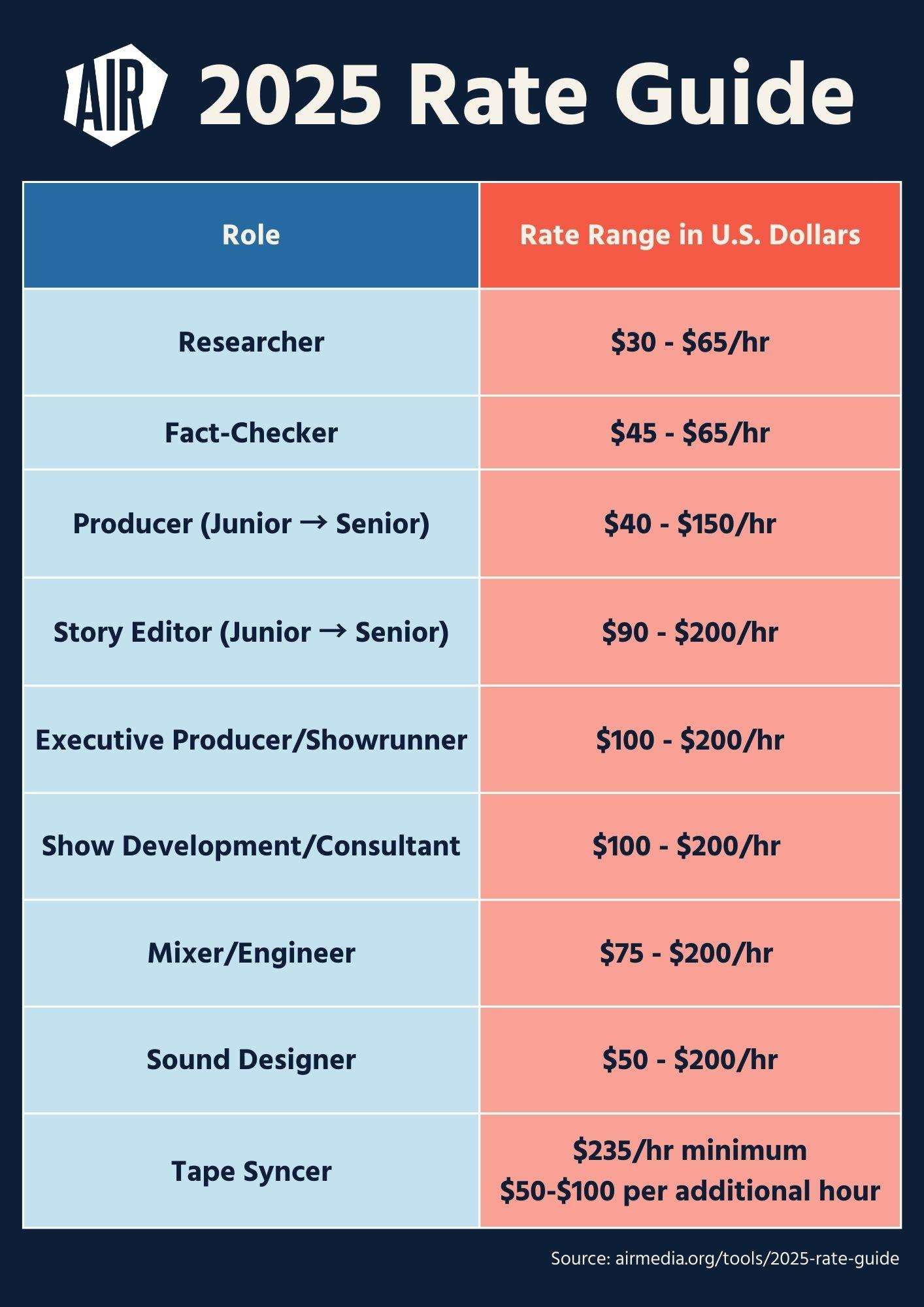
An Explanation of the Rates
"People need to understand that this is actually a profession. So many people are doing it in their basements that it feels like it's just like a hobby, but it's a real profession. And when you are doing something professional and skilled, it should have a price that reflects your expertise."
Researcher Rates
In our survey, some freelancers identified themselves as “researchers” while others cited research as one of the many skills they perform within the context of a larger position. The latter may skew the data slightly upwards, but the range still typically fell from $30 - $65 per hour depending on experience.
Fact-Checker Rates
Similar to research, fact-checking is one of the many skills a producer performs within the context of a larger position. While we only have data from about a dozen people who explicitly reported fact-checking rates, those fact-checkers mostly worked by episode or by project, averaging $45 - $65 per hour. We spoke to a few experienced fact-checkers who earn much more than that, especially if their contracts clearly lay out how many passes a fact-checker will take through an episode script.
Producer Rates
The rates for producers vary by experience and range from $40 - $150 per hour. The lower end is typically for Assistant / Associate Producers and the higher end is typically for Lead / Senior Producers.
"If somebody hired me to make a straight chat show, I'd be comfortable getting a little bit less because it's a lighter lift for me. But if somebody hired me for a long-form narrative show, I would want my full rate."
"I'm starting to get better at asking questions like: how many people are involved in this production? And I’m head down in the production, or am I coming to a lot of meetings? Am I talking to a lot of the different stakeholders? Am I creating and then maintaining the production calendar? Some of the shows that I work on now I'm a lead producer, and I never touch ProTools. So I'm going to take that into consideration, too. If I'm not ever touching ProTools, then I'll accept a slightly lower rate because it’ll be less technically intensive."
Story Editing Rates
Rates for story editors vary with experience. Newer editors (often experienced journalists who are new to editing or print editors who are new to audio) quoted rates between $90 - $125 per hour. More experienced editors typically charge $125 - $200 per hour.
"With narrative, you really need an editor. Because if you get an editor in early enough, they can shape the interview so that you're not then having to go back and do six more interviews, you're getting the right tape at the right time, and you can structure the story as much as you can in advance. You're actually lowering the overall costs by having a good editor."
"It's good to have editors.They save you money. They can anticipate problems. So it will pay off in the long run - in terms of disasters averted."
Executive Producer / Showrunner Rates
Executive producers or showrunners are typically the most experienced person on a team as they are ultimately responsible for the success of a show. The rate ranges from $100 - $200 per hour.
"I'm bringing on my 23 years of experience. So I’m doing a lot more than just patching things together and doing a simple mix. I’m helping them with every step along the way."
Show Development and Consulting Rates
Rates for show development or the broader “consulting” category vary widely based on many factors, but because this kind of work requires a significant number of years of experience in the field (or related fields) and typically requires fewer hours than a production role, the rate ranges from $100 - $200 per hour.
"The project I'm working on right now… they brought us on and had done no show development. I think a lot of people just get into it thinking all I need is a decent microphone. There's so much mystery around or… just like a lack of understanding around the amount of work that goes into a good podcast."
Engineering, Recording, and Mixing Rates
Independent engineers cited $75 - $200 per hour or day rates commensurate with that range. Additional fees are typical for rush jobs. Rates vary based on the complexity of the project and the experience level of the engineer.
Sound Design Rates
Sound designers told us it is challenging to determine their rate because of the creative nature of sound design work. Some episodes are straightforward and can be done quickly with music. Others are more complicated and require more time to develop unique sonic experiences. We talked to a few experienced producers who talked about the value of having a sound designer who can mix in order to get the sound and feel right. Many producers in the survey data also reported doing “sound design” work, and this may skew the data slightly downwards but the range for sound design still varies greatly from $50 - $200 per hour.
Composition Rates
Establishing “standard” rates for original music composition is particularly challenging because some composers can command substantially more for their work than others. For example, some composers take the ownership of the composition into account when setting their rates. If the production needs to reserve the right to use work exclusively, expect to pay significantly more for the license. Some productions will want to collaborate with a composer to develop original music, while other projects might be looking for non-exclusive use of an existing track from the composer’s library. What we’ve seen is that composers charge anywhere from $5000 - $8000 for original compositions.
Tape Sync Rates
In 2025, AIR announced a partnership with Tape Syncers United (TSU) to adopt their 2025 TSU Rate Guide into AIR’s freelancer toolkit. Visit the guide to learn more about tape sync rates. The suggested minimum total for the first hour is $235, with an additional fee of $50 - $100 for any hours after the first.
Roles and Responsibilities
This part of the guide identifies common industry roles and the tasks generally associated with them. Keep in mind that in practice, responsibilities may vary and overlap. An informed negotiation is essential for assuring fair pay and expectations. No reference document, including this one, can replace a well-defined agreement or contract.
Fact-Checker
Fact-checking is the process of establishing factual accuracy, the truth, or reality. Fact-checkers evaluate the quality of the evidence used to verify details of a script and ask whether information is used fairly, completely, and without bias. They determine if details are missing, out of context, exaggerated or oversimplified. Fact-checkers search for bias and evaluate context and tone.
Researcher
A researcher’s job is to look for information. This could be in the form of stories, guests, historical events, scientific findings, and more. A researcher might also gather archival materials, ambient sound, and/or scene tape. It is common for producers to cite research as a role they do within the context of a larger role. But there are cases in which someone will be hired exclusively for research.
Producers (multiple levels)
A producer is a catch-all term for a professional who performs the many tasks involved in radio and podcast work, including research, booking, reporting, sound gathering, interviewing, writing/scripting, voicing/narrating, cutting tape, and doing production mixes for whole features or episodes. Depending on the scope of any one project, a producer might lead a team or they might do it all themselves. They may see a whole season through or produce a single feature story or episode. A range of roles fall into the producer category, including assistant producer, associate producer, lead producer, senior producer, managing producer and executive producer. We’ve outlined the specific tasks that are often assigned to each role, but there’s a great deal of overlap and flexibility depending on the scope of the project and size of the team.
- Assistant / Associate Producer: These two terms are often used interchangeably, though in some cases an associate producer has a bit more experience than an assistant producer. In either case, these are typically entry-level roles for newer creators. APs are not necessarily expected to have technical experience with recording equipment or audio editing software though that varies by the project. Here are a list of tasks that are typically assigned to these roles, but this is by no means exhaustive:
- Research and gather archival materials, ambient sound, and scene tape
- Book guests, stringers, and studios
- Pre-interview and/or interview sources
- Prep hosts for interview tapings: research guests, prepare and send interview briefs
- Prep tape for table reads
- Edit interviews using audio editing software
- Put together rough mixes or layups using audio editing software
- Fact-check scripts
- Do a quality control (QC) listen to a mix to check for errors
- Create transcripts
- Upload audio to hosting platforms
- Write or edit show notes
- Produce ads, promos, bonus content, etc
- Create and distribute social media assets or other marketing materials
- Attend production and editorial meetings
- Pitch story ideas
- Lend general editorial feedback and administrative support
- Producer / Lead Producer / Senior Producer: These terms are often used interchangeably, though a lead or senior producer often identifies someone with several years of additional experience. Creators in this role are generally proficient with recording equipment and / or audio editing software. Their role on a project may include any of the tasks above plus some or all of the following:
- Conceive of original story ideas or work with a host / creator / client to execute their ideas
- Coordinate, run, and record interviews, troubleshooting technical and content issues
- Report, write, edit, and track episode / feature scripts
- Create high-quality mixes in audio editing software, which may include scoring and sound design
- Lead production and / or editorial meetings
- Organize and maintain production documents / spreadsheets, etc.
- Lend specific editorial feedback and administrative support
- Managing / Executive Producer or Showrunner: These terms are often used interchangeably but they generally signify a team leader, someone with proven experience. They typically manage both people and shows, supervising all elements of production from beginning to end, handling administrative and logistical duties and liaising between editorial, marketing, finance, legal, and operations. Their tasks may include any of the tasks above plus some or all of the following:
- Work with producers, hosts, and / or clients to develop story ideas and shape episodes
- Oversee show production and provide general guidance and support to host and producer/s on story ideas, timelines, production processes, and higher-level management of all show assets
- Create and maintain the production calendar
- Delegate production tasks as needed
- Lend timely editorial feedback and maintain quality control for all content
- Create and manage project budgets
- Organize and lead kick-off meetings and other production milestone events
- Supervise and train team members
- Troubleshoot production and communication challenges and navigate complicated situations that may arise in show production
- Remove roadblocks to production
Editor / Story Editor / Editorial Consultant
An editor, story editor, or editorial consultant typically refers to a person who works with producers, reporters, and/or hosts to refine and finalize the tone, content, and structure of a story, episode, or segment. We often use the term “story editing” to distinguish from “audio editing” (actually cutting the tape). Many editors are involved from the pre-reporting stage, to help frame the goals of the story. Some editors like to listen to a lot of raw tape early in the process, while others leave this task to the reporter or producer. Some editors will want to listen to a live read with tape. Overall, the editor’s role is to ensure that a piece is complete and accurate and that the narrative tells a compelling story. Editors tend to bring a number of years of experience with reporting and/or producing. It is not uncommon for an editor or editorial consultant to also take on managing producer / executive producer or showrunner tasks. Typically their tasks include the following:
- Shape overall narrative arcs through storyboarding or outlining
- Work with producers, hosts, and / or clients to craft scripts
- Provide structural feedback on early drafts and line edits on later drafts
- Participate in or direct narration tracking sessions and offer real-time feedback to hosts and producers
- Oversee fact-checking and / or legal review and make sure notes are incorporated accurately
- Listen to mixes and offer specific feedback on pacing, tone, scoring, narrative beats, etc.
- Consolidating and translating editorial feedback from multiple sources (producers, management, lawyers, etc.) to create a coherent and unified final project, sometimes involving rewrites of host copy/narration with collaborators
- Help identify audio clips and write copy for marketing or social media
- Write or edit episode descriptions
Audio Engineers and Sound Designers
An audio engineer is a broad term that can be applied to someone in any one of a variety of engineering-related roles. An engineer may have expertise in mixing, audio editing, sound design, and field recording. They are often trained to operate recording and broadcast studios.
A mix engineer ensures that sound is clear and consistent across a show or segment. Mixing is typically the final step of producing an audio story and results in an audio file that is ready for broadcast or publication. Mixing can include cleaning up the audio, smoothing transitions, placing the score, and balancing levels. A good mix engineer makes a world of difference in a show, especially when they are brought in early to head off problems with recording quality, file organization, or workflow that could be labor-intensive to fix later.
Mastering: In an audio storytelling context, “mastering”, or “mixing and mastering” generally refers to the final stage of production in which the engineer puts the finishing touches on a mix to make sure it’s ready for broadcast or podcast distribution. This can include loudness normalization, EQing, and creation of deliverables for distribution. In other contexts like music production, mastering is a well-defined skillset and process — but mastering in its traditional sense generally does not apply to audio storytelling. In this guide we include this step under “mix engineer” for the role and “mixing” for rates.
Sound design establishes the sound and feel of a show or episode. Sound design is an editorial and technical role. Most sound designers told us that they do their best work when they’re involved in a production from the start. On some shows, individual producers handle their own sound design, while others work hand-in-hand with a sound designer assigned to the project from the beginning of the process. In audio storytelling, a sound designer might provide music and pacing direction or customize a palette of music and sonic materials that form the defining sound of a show. A sound designer might compose original music themselves, find composers to create original sounds and music, or use sound libraries to identify and license existing music and effects. Often a sound designer's role is to build a cohesive scene out of field recordings.
Sound Recordist, Field Recordist, and Production Sound Recordist are all general terms that describe an audio engineer who records "in the field" outside of a studio. Such a recordist is able to set up equipment that will optimize recording quality given the constraints of the particular setting. Most reporters or audio producers bring their own recording equipment and record their own sound. However, circumstances do arise where a project needs a hands-on assist with field recording and only field recording.
Music Composition
A composer is a musician or musical artist who creates original music. A show might collaborate with a composer to create one new score or a library of original music, or they might license existing music from a composer. A show may request that the music be delivered in stems — separate audio tracks for groups of similar instruments (drums, keys, synths, bass, etc.) to allow for flexibility in how the music is used.
Scoring describes the work of creating original music or identifying, selecting, and licensing existing music from a music library or other source to suit the needs of a segment or story. Scoring also refers to placing or layering that music into a production mix. Sometimes a producer does the scoring. As we noted above, other times it’s done by a sound designer or a mix engineer.
Tape Syncer
Records remote interviews on location, for use in professional productions. Tape syncers are generally expected to own their own field recorders and microphones. They act as the eyes and ears for the production team. They may help choose a good recording location and troubleshoot issues on location. Tape sync rates are provided in collaboration with Tape Syncers United (TSU).
How to Figure Out Your Rate
"I just try to think holistically about why a job may or may not make sense."
No matter what kind of project you’re doing, we recommend figuring out your desired hourly rate and then calculating how many hours the project is going to take and negotiating appropriately. To figure out your hourly rate there are many things to consider including but not limited to:
- Years of experience
- Location / cost of living
- “Overhead” expenses which include things like insurance, taxes, computers, recording equipment, software, and anything that could reasonably qualify as “the cost of doing business.”
- Private sector vs public sector (for profit vs non for profit)
- Complexity of the project: Will the project require many passes or many rounds of edits? Are there a lot of stakeholders involved who will need to weigh in / sign off?
- Length of the project (short term vs long term)
- Pace of the project: Is it a last minute or rush job?
- Passion or “pain” of the project: Is the project especially interesting? Is the client or subject matter especially challenging? Does it require a specific or unique skill-set that few people have?
Almost no freelancer consistently earns the same hourly rate project over project; freelancers almost always adjust their rate based on a number of factors including those listed above.
"I had a situation in the past year where I accepted a rate that was lower than I thought it should be. I said yes to it because I needed the work, and it was work I wanted to do. So those were important factors. But I negotiated some other things around the edges. So it was sort of a thing where it's like, “I'm not going to get the money I quite think I merit, but I'm going to get some other things that I need.”
"I pick the number based on how many hours I think it's going to take and what is the number that is going to make me the least irritated with the project when I don't want to be doing it anymore."
Freelancers who have recently been in full time roles often figure out their hourly rate based on their previous salary.
"I wanted to equal my last salary… so I did all the math to figure out what I needed to charge to get that amount of money at the end of the year knowing that I wouldn't be working 40 hours a week for 52 weeks, knowing that it was freelance and that there would be downtime and that there would be time that I would have to work on my business. Then I did the backwards math to figure out what I needed to charge to get there."
"Now that I'm independent, I have to think about healthcare. I have to think about overhead, like expenses… I have to think about saving, I don't have a 401k now. I just opened up an IRA, but I have to contribute to that. So all that I didn't have to think about as a full-time employee, now I do have to think about every year, even every quarter."
Freelancers will sometimes base their hourly rate on the consistency of the work. For example, if they are guaranteed a steady amount of work over a long period of time, they will adjust their rate down. On the other hand, they might raise their rate for a short-term project, or one that only requires a few hours in a given week or month.
"When I was working for one company, I was willing to work for a lower hourly rate than usual. But I was working 15 to 28 hours a week for the company and so I knew that would be a lot of work. If you're going to be working fewer hours on multiple projects, you need to be charging a higher rate."
Once you figure out your desired hourly rate for a project, you can consider whether it makes sense to bill hourly or if it’s better to determine a project rate, a per-episode rate, a day rate, weekly rate, or monthly rate. Note: Weekly or monthly rates are sometimes referred to as “retainers.” These are generally arranged with long-standing clients who want to reserve some of the freelancers’ time on a regular basis.
A day rate is often calculated by multiplying the freelancer’s hourly rate by eight. In some cases, the freelancer will negotiate a slight discount when guaranteed a full day of work. For example, if the freelancer usually charges $100 per hour, they might only charge $700 or $750 per day (assuming they’ll work an eight-hour day.)
This method can also be used to calculate a weekly or monthly rate. However, it’s important to have a clear sense of the scope of work before determining how many hours you’ll be paid for in a given contract. AIR’s recommended best practice is to put a cap on the number of hours you will work in a given week or month.
"What I tend to do is say, “Let's agree on an hourly rate and put a max number of hours per week on it, and then let's stay in touch.” Because I know companies can't just offer unlimited funds. I understand that. And if it gets to be more than that or things are just not aligning with our expectations, let's keep talking and figure out what’s doable."
A scope of work is an outline of a given project from beginning to end. It covers many things including but not limited to:
- What role the freelancer is expected to play on a project
- What specific tasks are assigned to that role
- The number of episodes covered by the contract
- The amount of time the whole project is expected to take
- How many rounds of edits are expected on a given episode
- Who signs off on a given episode
Revisions: Experienced producers, editors, and engineers often include a fixed number of revisions in their contract, even for work that will ultimately be billed by the hour. Revisions, tweaks, corrections and adjustments are part of the work, but when those trickle in piecemeal, the freelancer can get stuck managing a lot of inefficient communication. Charging a higher rate for revisions after a set number of passes can help encourage efficiency and ensure that everyone is able to do their best work.
Project bleed or project creep occurs when the scope of work is not clearly defined and/or the hiring organization adds more work to the producer’s plate without amending the contract. This can be due to mismanagement or because something unexpected happens over the course of production. Even a handful of extra hours on a project will cause a freelancer’s hourly rate to drop.
"If I was staying in the range that I wanted in terms of hours per episode, I'd be making about $100 an hour, but it's probably closer to $65-70 right now just because I'm working a lot more than I expected. As an independent, you have to think about how long it will take you to make each episode. That's something that employers rarely keep in mind."
A few final notes:
What a freelancer sets out to earn and what they actually achieve are two different rates. The only way to know their actual rate is to track their time and divide their total income rate with the number of hours worked. We suggest doing this for each project and keeping detailed notes for future reference. Freelancing is an ever-evolving process; AIR encourages freelancers to pay close attention to their own hours and industry trends, and to adjust accordingly at every opportunity.
"My current main project is with an organization that's never made a podcast before so they didn't know what is considered fair or unfair… They do want to pay fair rates; they don't want to have people feel like they're being under-compensated or giving free labor. So having the AIR rate guide to point to is super helpful."
A note about video:
The addition of video to podcast production is changing production processes and the skills desired to produce a podcast. AIR has not focused on video production in this survey. We encourage producers to consider how many additional hours and skills are needed to produce video either instead of or in addition to audio and adjust their rates accordingly.
"I feel like when clients start asking for video and producers are asked to edit video and audio, then I think your rate should be higher. That's a whole other medium and developing that muscle takes time and I think for people who are doing both they should charge a premium."
A note about story reporting:
For this guide, AIR has focused on work-for-hire and independent production in the podcast landscape. Story reporting requires a very different process and calculation of hours. While we encourage freelancers to negotiate their rate in good faith, there are many variables to consider.
"In the case of the story I'm working on now, the rate is $7,500. If I was going to draw the line at, say, $50 per hour, that would be 150 hours. But, because it's an investigative, narrative story, I guarantee you I'm going to work way more than 150 hours on it. I spent almost two weeks in the field for this story. And I'm going to spend another 80 hours writing and editing. Hourly rates are a useful guideline and negotiating tool, but if you want to do time-intensive stories, sometimes you have to accept a lower hourly rate and then try to find other ways to make up for it."
AIR continues to work with outlets to help determine fair rates for creators. Our hope is to update the hourly rate guide every two years. In order to do so, AIR needs your support. You can make the biggest contribution to our work on rates by becoming a sustaining member or by making a donation.
Credits
The Rate Guide Committee comprises AIR’s Board of Directors Rob Byers, Will Coley, Mia Lobel, and Erin McGregor, AIR’s Program Manager.
Contributors:
Stan Alcorn, John Asante, Sona Avakian, Jason Barkhouse, Julia Barton, Jeanette Beebe, Allison Behringer, Ethan Bien, Jeremy Bloom, Gabby Bulgarelli, Angel Carreras, Sarah Collins, John DeLore, Karen Duffin, Robyn Edgar, Helena de Groot, Karen Given, Erica Huang, David Herman, Nichole Hill, Sarah Ivry, Jen Kinney, Sarah K Kramer, Juleyka Lantigua, Alex Lewis, Libby Lussenhop, Alison MacAdam, Sara McCrea, Ben Montoya, Rekha Murthy, Emma Munger, Rebecca Nolan, Ben Tolliday, Anne Pope, Lisa Pollak, Nina Porzucki, Audrey Quinn, Nick Ryan, Veronica Simonetti, Bart Warsaw, Nisha Venkat, Sarah Vitak, Stephanie Wolf, Wudan Yan, Ronald Young Jr.
Contribute to the Rate Guide
Have feedback or questions about the guide?
Contact: Giulia Hjort, Advocacy Associate – giulia@airmedia.org